
The Story Behind Garuda: Why This Symbol Belongs on Your Wardrobe
When we first designed the Garuda symbol for Matrikano, we knew we were working with something extraordinary. The Garuda is not just mythology — it’s a narrative about divine origin, unbreakable loyalty, and cosmic power so complete it defines the entire relationship between devotee and deity.
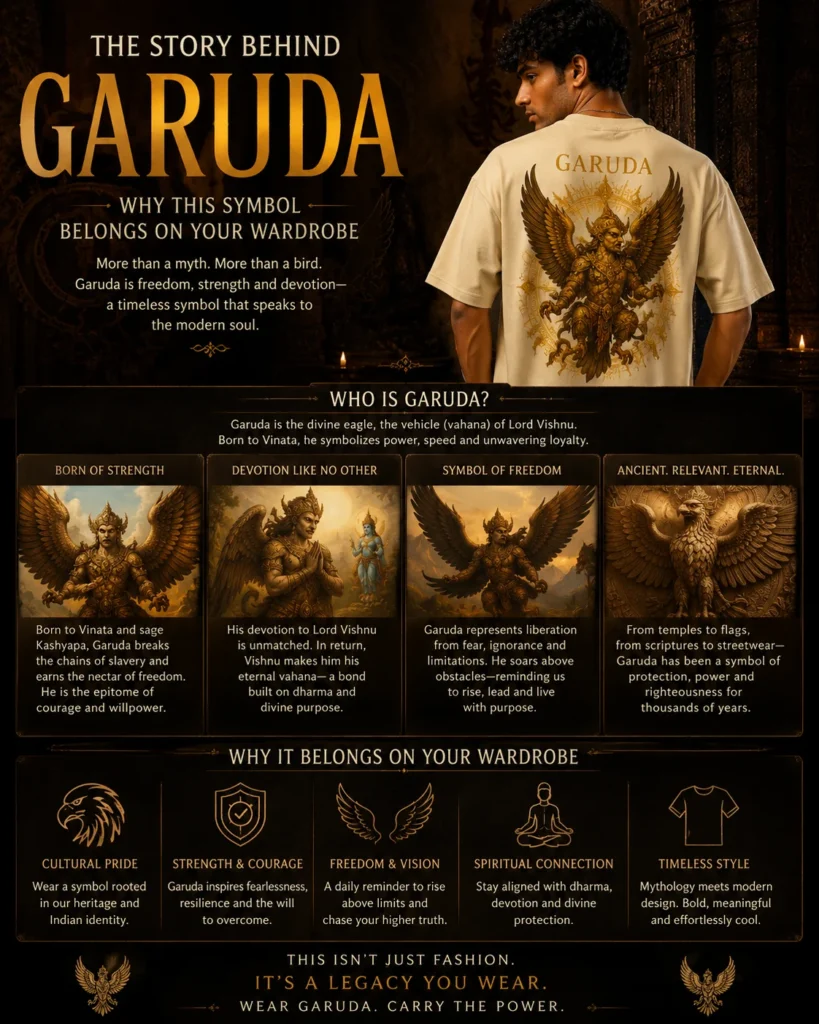
This post is my personal deep dive into why the Garuda symbol belongs on your wardrobe.
The Mythological Origin of the Garuda Symbol
According to the Mahabharata and Vishnu Purana, Garuda was born to the sage Kashyapa and his wife Vinata. His mother had wagered her freedom against Kadru, the serpentine mother of all nagas — and lost. From the moment he hatched, Garuda’s mission was clear: free Vinata from enslavement.
He flew to the heavens and stole the Amrita — the nectar of immortality — from the gods themselves. Not to drink it. Not to become immortal. But to exchange it for his mother’s freedom.
That single act — choosing devotion over personal power — is why the Garuda symbol carries so much weight even today.
What the Garuda Symbol Actually Represents
The Garuda symbol is one of the most layered icons in Hindu iconography. At its core, it represents:
- Speed and Strength — Garuda can traverse the three worlds in a single breath
- Devotion Over Power — He chose to serve Vishnu rather than reign supreme
- Victory Over Serpents (Nagas) — The destruction of ego, fear, and negativity
- Cosmic Loyalty — His bond with Vishnu is described as eternal and unconditional
- Freedom and Liberation (Moksha) — He freed his mother and himself from bondage
The Garuda symbol has been revered across Hindu, Buddhist, and Jain traditions for over 3,000 years. It even serves as the national emblem of Indonesia and the royal symbol of Thailand — proof of how far this icon’s power reaches.
Garuda in Classical Indian Art and Architecture
What fascinates me as a designer is how Garuda has been depicted across different classical traditions of Indian art. From the bronze Garudas of the Chola dynasty to the stone carvings of Vijayanagara temples — each interpretation tells a slightly different story.
The most iconic pose is the Garudasana — Garuda in flight with folded hands, carrying Vishnu. This is not a depiction of a predator. It’s a depiction of a devotee elevated to cosmic status.
At Matrikano, our Garuda symbol designs are directly inspired by these classical carvings. We studied temple friezes and museum collections to ensure our interpretation honors the visual language that ancient Indian craftspeople established centuries ago.
Why the Garuda Symbol Belongs on Modern Streetwear
There’s a growing movement in Indian fashion — a shift away from generic Western graphics toward designs rooted in our own mythology, philosophy, and art history. The Garuda symbol sits at the heart of this movement.
When you wear Garuda, you’re not just wearing a cool bird. You’re wearing a story that spans the cosmos. You’re wearing the concept of freedom earned through sacrifice. You’re carrying the symbol of the mightiest vehicle in Hindu cosmology.
Compare that to a random branded logo or a generic graphic tee. There’s simply no contest.
How We Design the Garuda at Matrikano
Our process starts with research. We study manuscripts, temple carvings, and museum archives. We want every line in our Garuda symbol graphic to have cultural legitimacy — not just aesthetic appeal.
The result is a design that works equally well on an oversized drop-shoulder tee worn in Mumbai or a heritage piece gifted to someone who understands the depth of what it represents.
If you want to explore our full mythology-themed collection, visit our Matrikano graphic tees collection — every piece tells a story rooted in classical Indian tradition.
Garuda’s Cross-Cultural Legacy
One of the most remarkable things about the Garuda symbol is how far it travelled beyond India. In Indonesia, Garuda Pancasila forms the national coat of arms. In Thailand, the Garuda is the royal emblem used on official state documents.
This cross-cultural adoption speaks to something universal in the Garuda archetype — the idea of a fierce, loyal protector who chooses service over dominance. That narrative resonates across cultures, religions, and centuries.
For more on Garuda’s mythological significance, the Wikipedia entry on Garuda provides a solid academic overview.
Conclusion: Wear What You Believe
At Matrikano, we don’t design T-shirts. We design wearable narratives. And the Garuda symbol — with its story of sacrifice, devotion, and cosmic power — is one of the most powerful narratives in human culture.
If you’re someone who believes in what you wear, if you want your clothes to mean something deeper than a brand name, then the Garuda belongs on your wardrobe.
Explore our mythology-inspired T-shirts at Matrikano and find the symbol that speaks to your story.
Frequently Asked Questions
What does the Garuda symbol mean?
The Garuda symbol represents speed, strength, devotion, and the victory of good over evil. In Hindu tradition, Garuda is the divine vehicle of Lord Vishnu and embodies cosmic loyalty, liberation, and the destruction of negativity.
Is the Garuda symbol only Hindu?
No. While rooted in Hindu mythology, the Garuda symbol is also revered in Buddhist and Jain traditions. It serves as a national symbol in Indonesia and Thailand, showing its influence across South and Southeast Asian cultures.
Why is Garuda depicted with wings and a human body?
Garuda is traditionally depicted as a divine being — part eagle, part human — symbolizing the bridge between the earthly and the divine. The eagle form represents power and transcendence, while the human form represents consciousness and devotion.
Where can I buy a Garuda symbol T-shirt in India?
Matrikano offers authentically designed Garuda symbol T-shirts inspired by classical Indian temple art. You can explore the full collection at matrikano.com.