
Indian Mythology Fashion vs Greek Mythology Streetwear: Why Desi Streetwear Is Finally Winning
Table of Contents
Walk into any streetwear store in London, New York, or Tokyo and you’ll find Zeus. You’ll find Medusa. You’ll find Thor’s hammer on a hoodie and Poseidon’s trident on a cap. Western mythology has been streetwear’s default inspiration for over a decade — and it’s made billions.
Meanwhile, Arjuna, Kali, Hanuman, and Nataraja sat mostly off the racks.
Not because the stories were smaller. Not because the visual language was less powerful. But because nobody had built the cultural infrastructure to put them there — the brands, the design vocabulary, the unapologetic pride that says: our mythology is as epic as yours, and it belongs on a t-shirt.
That’s changing. Indian mythology fashion is having its moment, and brands like Matrikano are leading it. This blog is about why it’s happening, why it took this long, and why desi streetwear is not catching up to Western mythology fashion — it’s building something the West can’t replicate.
How Greek and Norse Mythology Built a Fashion Empire
To understand where Indian mythology fashion is headed, you need to understand how Western mythology got there first.
Greek and Norse mythology entered mainstream fashion through a very specific pipeline. Hollywood gave us Clash of the Titans, Thor, and 300. Comic books gave us Hercules and Loki as pop culture figures. Video games like God of War and Assassin’s Creed Odyssey gave a generation of players deep, visceral relationships with figures like Zeus and Kratos.
By the time streetwear brands started printing Medusa heads and Olympic pantheon imagery, the cultural familiarity was already there. Versace’s Medusa logo wasn’t a gamble — it was riding a wave that had been building for decades through film, television, comics, and games.
The result was a Greek mythology streetwear industry worth hundreds of millions globally. Brands like Versace, Alexander McQueen, and dozens of streetwear labels built their visual identity on mythology that most of their customers recognized without a single word of explanation.
According to the Business of Fashion, cultural storytelling embedded in clothing has become one of the most powerful drivers of brand identity in the post-logo fashion era — consumers aren’t just buying clothes, they’re buying narrative.
Indian mythology had the narrative. What it lacked was the infrastructure to deliver it.
Why Indian Mythology Was Missing from Fashion — Until Now
Here’s the honest answer: Indian mythology fashion was held back by a combination of cultural hesitation, design gatekeeping, and a lack of brands willing to own the space with confidence.
For a long time, putting Hindu gods on t-shirts felt like it occupied an uncomfortable middle ground. Too sacred for some families, too unfamiliar for international buyers, too easy to get wrong for brands who hadn’t done the cultural homework.
The result was a gap. Either you got deeply traditional religious imagery sold in temple markets — not streetwear — or you got vague “spiritual” aesthetics that borrowed Sanskrit words and mandala patterns without any real cultural grounding.
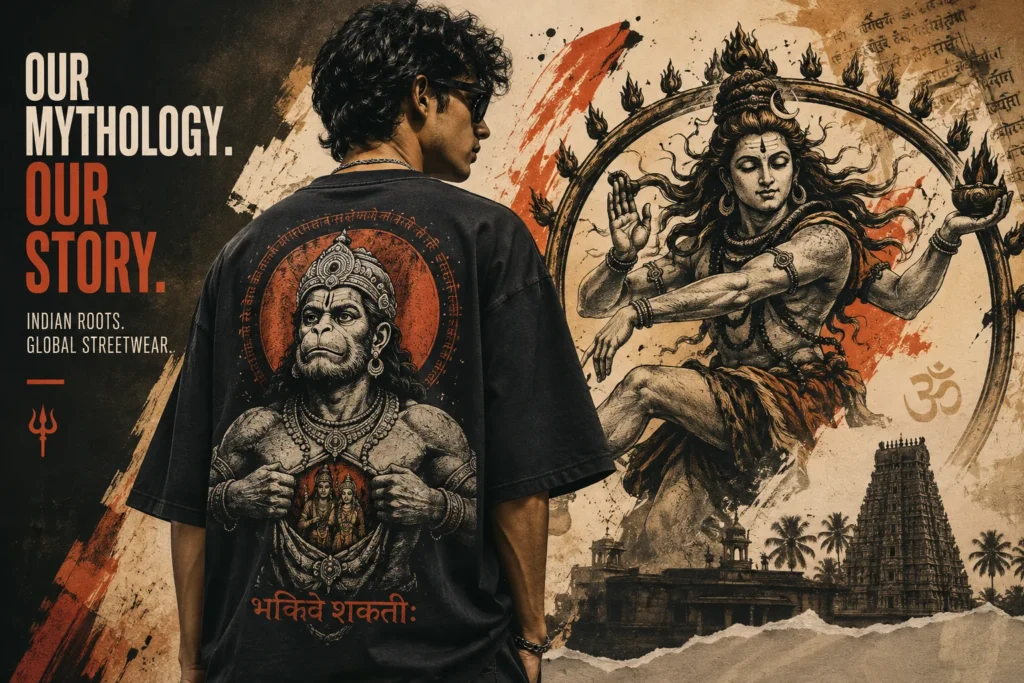
Neither was desi streetwear. Neither spoke to the Gen Z Indian who grew up watching Mahabharat on weekend mornings, studying for boards, and listening to hip-hop in the evening. Neither told that person: your mythology is cool. Your stories are epic. Wear them.
That generation is now in its twenties and early thirties. It has spending power. It has cultural confidence. And it has a growing impatience with fashion that doesn’t reflect where it comes from.
Matrikano was built for exactly this moment — Hindu mythology graphic tees designed with cultural research, artistic seriousness, and the assumption that the buyer knows their Mahabharata and wants a brand that does too.
Also on Matrikano: The Story Behind Our Mythology Designs — How We Research Before We Draw
What Indian Mythology Actually Brings to Fashion That Greek Mythology Can’t
Let’s be direct about something the fashion world is slowly waking up to: Indian mythology is, by most measures, the richer visual and narrative universe.
Not better. Not more valid. But richer — in sheer volume, complexity, and visual variety.
Greek mythology has roughly a dozen major gods and a few hundred stories. The Hindu pantheon has thirty-three primary deities, hundreds of secondary ones, and a textual tradition — the Vedas, Puranas, Upanishads, Mahabharata, Ramayana, and regional folk epics — that runs to millions of verses. The Mahabharata alone is roughly ten times the length of the Iliad and Odyssey combined.
The visual language is equally dense. Nataraja’s cosmic dance. Kali standing on Shiva. Vishnu reclining on the cosmic serpent Ananta. Hanuman tearing open his chest to reveal Ram and Sita within his heart. Arjuna’s bow raised at Kurukshetra. Each of these is an image so layered with meaning that a single t-shirt design could tell a story that takes an hour to fully explain.
Greek mythology streetwear offers recognizable symbols. Indian mythology fashion offers entire worlds.
This is not a small difference. For a generation that wants clothing with depth — not just aesthetics — it’s the entire reason desi streetwear is winning.
The Desi Streetwear Movement — Cultural Identity as a Fashion Statement
Something larger is happening alongside the rise of Indian mythology fashion, and it’s worth naming clearly.
For two decades, the aspirational fashion narrative for young urban Indians was essentially Western. International luxury brands, global sneaker culture, American streetwear aesthetics. The aspiration was to dress like you could be from anywhere — which often meant dressing like you were from nowhere in particular.
That aspiration is shifting. Cultural identity fashion is becoming the new luxury — not because Indian brands are cheaper, but because they’re more specific. A Shiva graphic tee from a brand that understands the Ardhanarishvara iconography hits differently than a generic tattoo-style design pulled from a stock image library.
Gen Z buyers — particularly in metro India and the Indian diaspora — are increasingly drawn to clothing that reflects who they actually are. The same cultural moment that’s driving the global rise of K-pop merchandise, African streetwear brands, and Latin American fashion designers is driving desi streetwear. The world is getting specific. Generic is losing.
Academic research from the NIFT — National Institute of Fashion Technology has noted the rising consumer interest in regional and cultural identity expression through apparel as a documented trend in the Indian market, particularly among buyers aged 18–35 in urban centres.
Indian Mythology Fashion vs Greek Mythology Streetwear — A Direct Comparison
| Element | Greek / Norse Mythology Fashion | Indian Mythology Fashion |
|---|---|---|
| Source material depth | Hundreds of stories | Millions of verses across multiple epics |
| Visual complexity | High — but well-mined | Extremely high — largely untapped |
| Global brand presence | Established (Versace, McQueen, Nike colabs) | Emerging — enormous room to grow |
| Cultural authenticity risk | Low — distance from origin culture | Higher — requires genuine cultural research |
| Emotional resonance for Indian buyers | Moderate — culturally borrowed | Extremely high — personal, inherited, lived |
| Design vocabulary | Gods, weapons, creatures | Gods, mudras, cosmology, regional art forms |
| Storytelling depth per design | Single-layer reference | Multi-layer cultural narrative |
| Who wears it with pride | Global general audience | Indian diaspora + global mythology enthusiasts |
| Leading Indian brand | — | Matrikano |
The column on the right has a head start of about a decade to make up — but it also has something the left column can never build: authenticity that comes from being the origin culture, not the borrower.
What Makes Matrikano Different in the Indian Mythology Fashion Space
Any brand can put a Shiva silhouette on a black t-shirt. What Matrikano does is different — and the difference is worth understanding before you buy.
Research before design. Every mythology design at Matrikano begins with cultural and textual research — understanding the specific story, iconographic tradition, and regional artistic language behind a figure before a single line is drawn. A Nataraja design that doesn’t understand the cosmic dance tradition of the Chola bronze period is just a silhouette. Matrikano’s designs are informed.
Art, not clip art. The Hindu mythology graphic tees at Matrikano are artwork — original compositions created with the same seriousness a gallery piece would receive. The prints are not stock images with a font overlay. They are designed for people who know the mythology and will notice the details.
Fabric worthy of the design. Premium artwork on a cheap tee is a disappointment. Matrikano uses 180–220 GSM combed cotton with bio-wash treatment — fabric that holds a detailed print, survives repeated washing, and feels as considered as the design printed on it. (Read the full fabric guide: What 180–220 GSM Cotton Really Means for Your T-Shirt.)
Cultural confidence without appropriation. This is a brand designed by people who grew up with these stories — not a brand that discovered Indian mythology as a trend. That distinction shows in how the designs handle sacred imagery: with care, with understanding, and with respect for what the iconography actually means.
Also on Matrikano: Our Full Mythology Collection — Shiva, Kali, Arjuna, Hanuman, and More
Who the Indian Mythology Fashion Movement Is Really For
The rise of desi streetwear is not just for people born in India. The audience is broader and more interesting than that.
Young urban Indians who grew up with the Mahabharata and Ramayana as living stories — not just dusty school curriculum — and want fashion that reflects their actual cultural identity.
The Indian diaspora worldwide — in the UK, US, Canada, UAE, Singapore, and Australia — who often feel caught between two cultures and find in Indian mythology fashion a way to carry where they’re from without being costume-y about it.
Global mythology and folklore enthusiasts who are bored of the same Greek pantheon for the tenth time and are genuinely curious about the visual language of Hindu cosmology. The global appetite for non-Western mythology is real and growing — see the success of mythology-themed games, manga, and fiction that draws from Hindu, Egyptian, and Aztec traditions.
Anyone who cares about design depth — people who want their t-shirt to have a story behind it, not just an aesthetic. A Matrikano mythology tee is a conversation starter because the story behind it is worth having.
Frequently Asked Questions About Indian Mythology Fashion
Why is Indian mythology not as common in streetwear as Greek mythology?
Greek and Norse mythology entered mainstream fashion through decades of Hollywood films, Marvel Comics, and video games that made figures like Zeus, Thor, and Medusa instantly recognizable to global audiences. Indian mythology lacked that same pop culture pipeline for international markets, and domestically, there was cultural hesitation about commercializing sacred imagery. That’s changing rapidly as a new generation of Indian designers and brands approach the space with both cultural confidence and commercial seriousness.
Is it culturally appropriate to wear Hindu gods on a t-shirt?
This is a question worth taking seriously. The general position in Indian cultural and spiritual communities is that wearing deity imagery with knowledge, respect, and care is different from wearing it as a purely decorative trend without understanding. Brands like Matrikano design specifically for buyers who know and value the mythology — the goal is always cultural celebration, not exploitation. Buyers should use their own judgment based on their relationship to the tradition.
How is desi streetwear different from regular Indian ethnic fashion?
Desi streetwear sits at the intersection of Indian cultural identity and global streetwear aesthetics — it’s not traditional kurtas or festival wear, and it’s not Western-influenced fashion that happens to be made in India. It’s graphic tees, hoodies, and casual clothing that carry specific cultural stories, symbols, and art forms from the Indian subcontinent, designed for everyday urban wear. The mythology, folk art, and regional cultural references are the point — not a decorative afterthought.
What Indian mythology characters are most popular in fashion design?
Shiva — particularly the Nataraja form — is the most widely represented deity in Indian mythology fashion, likely because of the strong visual drama of the cosmic dance. Kali, Hanuman, Arjuna at Kurukshetra, Vishnu in the cosmic ocean, and Durga are also popular subjects. The Mahabharata and Ramayana provide narrative moments that work particularly well as graphic design — characters with weapons, battles, and mythological creatures that translate powerfully into visual art.
Are Indian mythology t-shirts only for Indian buyers?
Not at all. Indian mythology fashion is increasingly attracting global buyers who are curious about non-Western mythological traditions — particularly those who feel that Greek and Norse mythology has been over-mined by mainstream fashion. The visual richness of Hindu iconography, the depth of the stories, and the distinctive artistic traditions (Tanjore painting, Pattachitra, Madhubani, Chola bronzes) give Indian mythology designs a look that stands completely apart from anything in Western streetwear.
Where can I find authentic Indian mythology streetwear in India?
Matrikano is one of the few Indian brands approaching Hindu mythology graphic tees with genuine cultural research, original artwork, and premium fabric quality. Their collection covers Mahabharata, Ramayana, and Puranic mythology, with designs that are informed by the actual iconographic traditions behind each figure — not just visually inspired by them.
Why is Indian mythology fashion growing now specifically?
Several forces are converging. A generation of young Indians who grew up confident in their cultural identity is now the primary consumer market. The global rise of cultural identity fashion (K-pop merch, African streetwear, Latin American designers) has normalized the idea that non-Western cultures should have their own fashion voice. Social media has created global audiences for niche cultural aesthetics. And brands like Matrikano have done the work of building a product that actually deserves the demand.
The Shift Has Already Happened — Indian Mythology Fashion Is Here
Greek mythology gave fashion Medusa. Norse mythology gave it Thor’s hammer. Both are powerful symbols — and they’ve had their run.
Indian mythology is offering something that took 5,000 years of storytelling to build: a visual and narrative universe so deep that you could design ten t-shirts a week for a decade and still barely scratch the surface.
Kali standing in the cremation ground. Arjuna and Krishna on the chariot before the war begins. Hanuman crossing the ocean with a mountain in his hand. Shiva opening the third eye. Vishnu dreaming the universe into existence.
These are not niche stories. These are the stories that one-sixth of humanity grew up with. And desi streetwear is finally building the fashion infrastructure those stories deserve — with the cultural confidence, artistic depth, and design quality to make them land.
Matrikano is where that conversation is happening in India right now. Explore the full mythology collection — and wear the story you’ve always known.
Browse the complete range of Indian mythology t-shirts, regional culture tees, and desi streetwear at matrikano.com.