
Ardhnarishwar: The Divine Union of Shiva and Shakti — What This Symbol Means for Modern India
When we were developing the Ardhnarishwar design for Matrikano, I kept coming back to one thought: this is not just a mythological image. This is a philosophical statement that has never been more relevant than it is today.
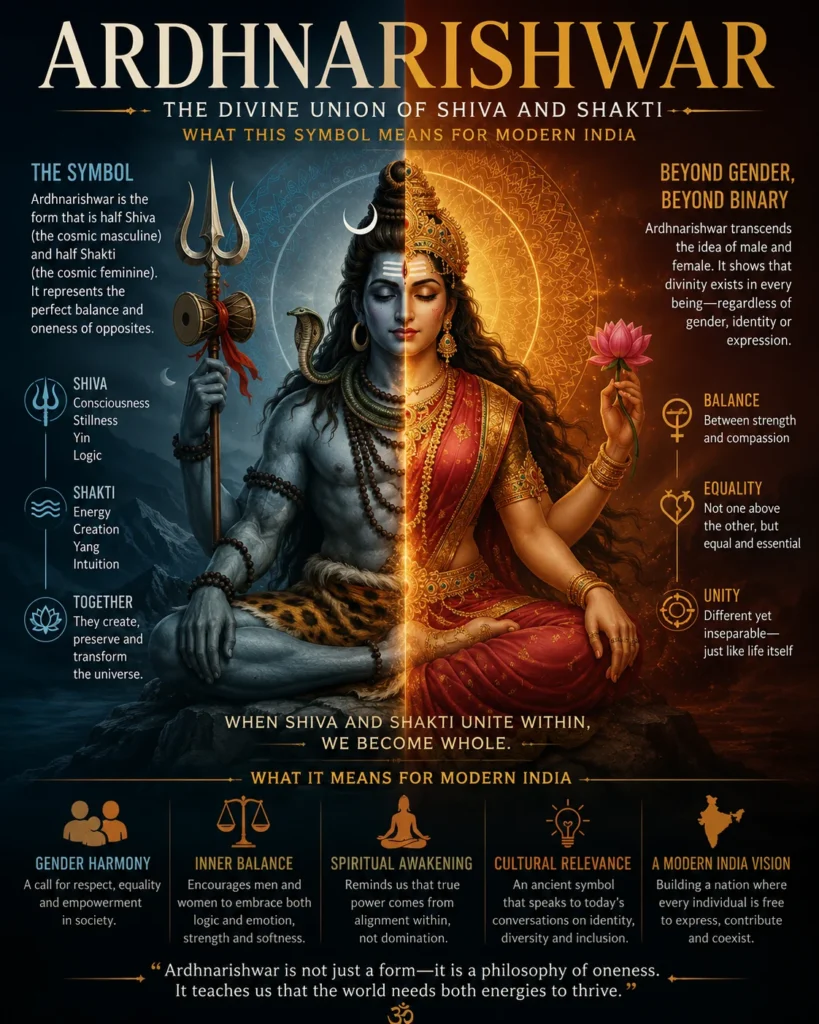
The Ardhnarishwar symbol — the composite form of Shiva and Shakti, half-male and half-female — is one of the most profound concepts in Hindu cosmology. And as someone who has spent years studying classical Indian iconography, I believe it deserves a place in modern Indian streetwear.
What Is Ardhnarishwar?
Ardhnarishwar (Sanskrit: अर्धनारीश्वर) literally means “the Lord who is half woman.” The name breaks down as ardha (half), nari (woman), and ishwara (lord). The form depicts Shiva and his consort Parvati — or Shakti — merged into a single being, split vertically down the center.
The right half is traditionally Shiva — associated with consciousness, stillness, and transcendence. The left half is Parvati/Shakti — associated with energy, creation, and material manifestation. Together, they form a complete cosmic reality.
This is the core insight of the Ardhnarishwar concept: the universe cannot exist through consciousness alone, nor through energy alone. Both are needed. Both are inseparable.
The Mythological Origin of Ardhnarishwar
According to the Shiva Purana and Linga Purana, the form of Ardhnarishwar was first revealed to Brahma when he was struggling to populate the universe. His mind-born sons, the Manas Putras, refused to procreate and populate creation.
Brahma prayed to Shiva for guidance. In response, Shiva appeared in the Ardhnarishwar form — showing Brahma that creation requires both the masculine and feminine principles working as one. Parvati then separated from Shiva and blessed Brahma with the ability to create life through sexual union.
This mythological origin is itself a philosophical lesson: the divine feminine is not secondary to the masculine. Both are primary. Both are necessary.
What the Ardhnarishwar Symbol Represents
The Ardhnarishwar symbol carries multiple layers of meaning that resonate across philosophy, science, and everyday life:
- Unity of Opposites — Masculine and feminine, stillness and motion, spirit and matter
- Wholeness — The idea that a complete universe requires both Purusha (consciousness) and Prakriti (energy)
- Gender Transcendence — An ancient Hindu affirmation that gender is not a binary division but a cosmic spectrum
- Creation and Destruction — Shiva’s destructive energy balanced by Shakti’s creative power
- Balance Within — Every individual contains both masculine and feminine energies
The Ardhnarishwar form has appeared in Indian art for over 2,000 years — from Gupta-period sculptures to Chola bronzes — consistently representing this vision of cosmic balance.
Ardhnarishwar in Classical Indian Art
The artistic representations of Ardhnarishwar are among the most sophisticated in all of Indian sculpture. The right side (Shiva) typically bears a matted jata (dreadlocks), a trident, and ascetic markings. The left side (Parvati) shows a rounded breast, elaborate jewelry, a lotus, and the graceful tribhanga posture.
Some of the most celebrated examples include the Ardhnarishwar panel at Elephanta Caves in Mumbai and the Chola bronze at the National Museum in Chennai. Both demonstrate extraordinary artistic skill in depicting two divine natures within a single form.
At Matrikano, our Ardhnarishwar design draws from these classical traditions. We spent significant time studying the iconographic canon before finalizing our interpretation — because representing a deity of this depth requires more than aesthetic instinct. It requires knowledge.
Why Ardhnarishwar Belongs on Modern Indian Streetwear
India’s streetwear scene is in a cultural renaissance. Young Indians are reclaiming their mythology not as museum artifacts, but as living philosophy. And no concept is more alive for today’s generation than the one at the heart of Ardhnarishwar: the idea that strength and grace, logic and intuition, action and stillness are not opposites. They are partners.
When you wear the Ardhnarishwar symbol, you’re not just wearing a striking visual. You’re wearing a 2,000-year-old argument against all binary thinking — against the idea that you must choose between power and compassion, between ambition and peace.
How We Approached the Ardhnarishwar Design at Matrikano
Our design team began with the Gupta and Chola sculptural traditions as reference. We wanted to preserve the iconographic integrity of the form — the specific visual language that identifies Shiva’s half versus Parvati’s half — while translating it into a graphic that works at T-shirt scale.
The result is a piece that works both as streetwear and as wearable art. Explore our full mythology-inspired T-shirt collection at Matrikano to see how we bring these stories to life.
Ardhnarishwar and the Philosophy of Balance
One of the things I find most compelling about the Ardhnarishwar concept is how it maps onto modern thinking about duality and integration. Ancient Vedantic philosophy understood something that Western thought is only recently articulating: reality is not made of opposites in conflict. It’s made of complementary principles in union.
This is why the Ardhnarishwar form has survived 2,000 years of changing empires, religions, and philosophies. Its message is timeless.
For an academic perspective on this form, the Wikipedia article on Ardhanarishvara offers a comprehensive overview of its history and scholarly interpretations.
Conclusion: Wear the Balance
At Matrikano, we believe clothing can carry meaning. The Ardhnarishwar symbol is one of the most meaningful icons in all of Indian culture — a visual representation of the unity that underlies all apparent division.
If you’re looking for a piece that starts conversations, challenges assumptions, and connects you to thousands of years of Indian philosophical tradition, our Ardhnarishwar T-shirt is made for you.
Explore our full mythology-themed wardrobe at Matrikano and find the symbol that speaks to your story.
Frequently Asked Questions
What does Ardhnarishwar mean?
Ardhnarishwar means “the Lord who is half woman” in Sanskrit. It represents the composite form of Shiva (masculine consciousness) and Parvati/Shakti (feminine energy), symbolizing the inseparable unity of all complementary forces in the universe.
Why is Ardhnarishwar split vertically?
The vertical split in the Ardhnarishwar form represents the equal standing of masculine and feminine principles — neither above the other, neither subordinate. The right side is traditionally Shiva and the left is Parvati, though some regional traditions reverse this.
Is Ardhnarishwar a symbol of gender equality?
In many interpretations, yes. The Ardhnarishwar concept is one of Hinduism’s most ancient articulations of the equal and interdependent nature of masculine and feminine energies. Many scholars and practitioners see it as a profound statement of gender complementarity and balance.
Where can I find an Ardhnarishwar T-shirt in India?
Matrikano offers authentically designed Ardhnarishwar T-shirts inspired by classical Indian temple art. Browse the collection at matrikano.com.