
Who Was Karna — Hero, Villain, or the Question the Mahabharata Refuses to Answer?
I grew up hearing two versions of the Mahabharata. In one, Karna was the enemy — the man who called Draupadi a “charioteer’s son’s wife” and sided with Duryodhana when the world was burning. In the other, he was the greatest warrior who ever lived, a loyal friend, and a man so cursed by fate that every step of his life was an unfair punishment for being born wrong.
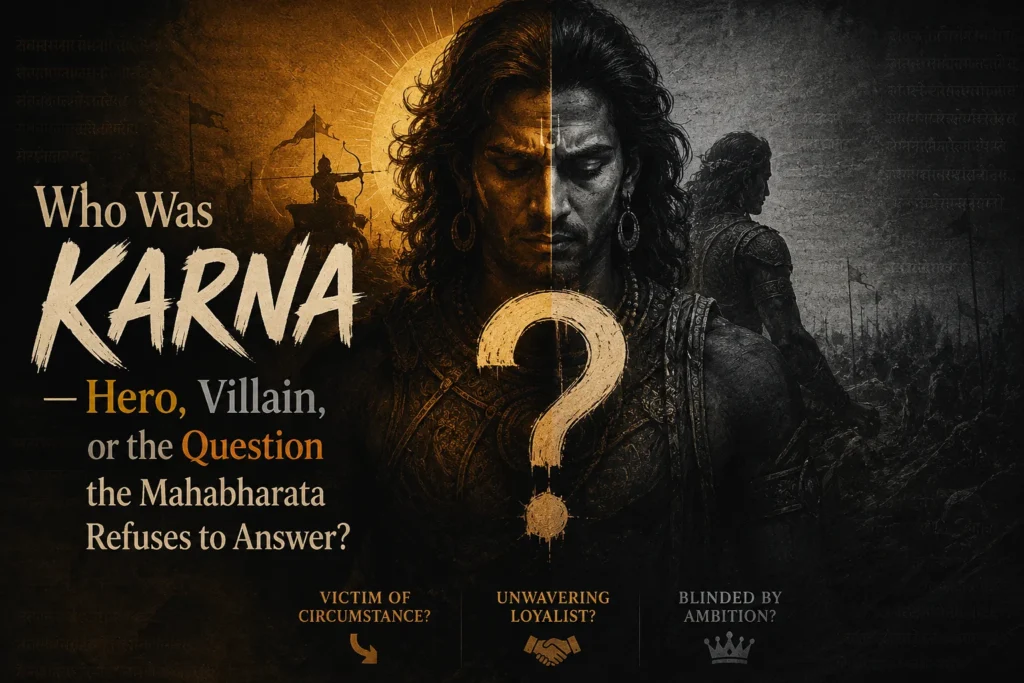
Neither version felt complete. And that, I later realized, is exactly the point.
The Mahabharata doesn’t offer you a clean answer about Karna’s character. It offers you a mirror. And what you see depends on what you bring to it.
The Birth of a Tragedy — Karna’s Story Begins in Abandonment
Long before Karna picked up a bow, his story was already complicated. Born to Kunti — a princess who had invoked a boon from the sun god Surya before her marriage — Karna came into the world wrapped in divine armor (Kavach) and golden earrings (Kundala). He was literally born protected.
And then he was abandoned.
Kunti, unmarried and afraid, placed him in a basket and set him afloat on a river. He was found and raised by Adhiratha, a charioteer, and his wife Radha. This is why Karna is also called Radheya — son of Radha — a name he wore with more pride than any royal title.
Here’s what most retellings skip: Karna never resented his foster parents. Not once. Even after he discovered his true identity, he refused to claim Kunti as his mother in any meaningful way. For him, Radha was his mother. That loyalty — quiet, fierce, unconditional — tells you more about Karna than any battlefield scene ever could.
At Matrikano, we study the Mahabharata not just as history or myth but as a living record of human moral complexity. And Karna might be its most honest character.
The Wound That Never Healed — Caste, Rejection, and Karna’s Identity
The turning point in Karna’s life came at a gurukul tournament in Hastinapura. Young Karna, trained secretly by Parashurama, stepped forward to challenge Arjuna. The crowd cheered. The performance was breathtaking.
And then Kripacharya asked: What is your lineage? A kshatriya prince cannot compete with someone of unknown birth.
In that moment, Karna — who could match Arjuna arrow for arrow — was disqualified not for his skill, but for his caste. It was Duryodhana who stepped forward, declared Karna the king of Anga, and gave him the dignity everyone else had denied.
Was Duryodhana doing it out of genuine friendship or political calculation? Probably both. But Karna didn’t care. He had been seen. He had been given a kingdom and a title and a place to stand. And that debt — a debt of dignity — he repaid with his life.
This is the part of Karna’s story that makes the hero-villain debate impossible to settle. His loyalty to Duryodhana is his greatest virtue and his greatest failing at the same time.
Related read on Matrikano: The Friendship of Karna and Duryodhana — Loyalty or Blind Allegiance?
Was Karna a Hero? The Case for Yes
Let’s be honest: Karna’s heroic qualities are undeniable.
He gave without condition. Karna was famous for never turning away anyone who came to him at sunrise. He was a daanveer — a giver of gifts — and he lived it literally. When Indra came disguised as a brahmin and asked for his divine Kavach and Kundala, Karna gave them. He knew it would cost him his natural protection. He gave them anyway.
He kept his word even when it hurt. When Kunti approached him before the war and begged him not to kill her Pandava sons, Karna agreed — but only up to a point. He promised he would spare four of the five. He would only fight Arjuna. He kept that promise, even though he could have changed the war’s entire course by breaking it.
He faced humiliation and chose dignity over bitterness. Draupadi’s swayamvar, the tournament rejection, Parashurama’s curse when he discovered the truth about Karna’s birth — Karna was handed injustice at every turn. He could have collapsed inward. Instead, he stood straighter.
For more on Karna’s generosity and moral code, scholars like Irawati Karve in her landmark essay collection Yuganta have argued that Karna represents the Mahabharata’s most complete study of human dignity under pressure.
Was Karna a Villain? The Case You Can’t Ignore
And yet.
Karna was present — silent, laughing, or both — when Draupadi was dragged into the Kaurava court. He called her vaishya (a woman of low standing) and suggested she had already been “won” and lost enough times that her honor was forfeit. Whether he spoke those words out of cruelty, political loyalty, or social conditioning, he spoke them.
He fought on the side of Duryodhana, a man who tried to have the Pandavas burned alive, who cheated at dice, who orchestrated humiliation after humiliation. Karna knew this. He wasn’t naive. He simply chose not to leave.
During the battle of Kurukshetra, there are moments when Karna’s conduct is difficult to defend. The killing of Abhimanyu — the teenage warrior trapped in the Chakravyuh — involved Karna cutting Abhimanyu’s bow. It was technically allowed. It was also deeply dishonorable.
He had choices. He made them. And some of those choices caused real suffering.
This is where Karna’s character analysis gets uncomfortable: heroism and moral failure can live in the same person. The Mahabharata knows this. Most retellings don’t want to.
What Matrikano Believes — Karna as the Epic’s Most Human Character
At Matrikano, we’ve spent years exploring the characters of Indian mythology not as symbols to worship or villains to reject, but as fully realized human beings with contradictions intact.
Karna is not a hero. He is not a villain. He is something harder to hold: a man shaped by every wound he received, making choices that were understandable and sometimes wrong, generous and sometimes cruel, loyal to a fault and wise enough to know it.
The Mahabharata gives him no resolution. His real mother only claims him publicly after he is dead. The divine armor that could have saved him was given away by his own choice. Even his death — wheel stuck in the earth, weaponless, at the hands of Arjuna who was reminded by Krishna of every rule Karna himself had once broken — feels like the universe making a dark, ironic point.
He is the only character in the epic who is cursed by every teacher he ever had. Parashurama cursed him when he found out Karna had lied about his caste to receive training. A brahmin cursed him when his chariot wheel accidentally killed a cow. The earth herself cursed him to forget his training at the critical moment.
What do you do with a man like that? You sit with the discomfort. You don’t resolve it.
Karna vs. Arjuna — The Real Comparison
| Aspect | Karna | Arjuna |
|---|---|---|
| Birth | Abandoned by royalty, raised by commoners | Born into the Pandava royal line |
| Divine gifts | Natural Kavach-Kundala; gifted spear from Indra | Gandiva bow; had Krishna as his guide |
| Loyalty | To Duryodhana, unconditionally | To dharma — but guided throughout by Krishna |
| Moral complexity | High — choices made without divine counsel | High — but with active divine support |
| Generosity | Legendary; called Daanveer Karna | Skilled warrior; generosity less emphasized |
| Death | Unarmed, cursed, wheel stuck in earth | Survived the war; completed his dharma |
The Mahabharata sets them up as mirrors. Arjuna had every advantage Karna lacked. Karna had natural gifts — and had them stripped away one by one. The war between them isn’t just personal. It’s almost philosophical.
Explore more at Matrikano: Arjuna’s Doubt vs. Karna’s Certainty — Two Kinds of Courage
Who Was Karna Really For?
Karna speaks to anyone who has ever been told they don’t belong — in a room, in a family, in a system. Anyone who has worked twice as hard for half the recognition. Anyone who has been loyal to people who didn’t deserve it, because loyalty itself felt like the only thing that was truly theirs.
He is the patron character of every person who was brilliant and overlooked, generous and taken for granted, proud and quietly devastated.
That’s why Karna from the Mahabharata resonates differently across generations. He doesn’t give easy comfort. But he gives company — the rare kind that says yes, life can be this unfair, and you can still stand up.
For a deeper exploration of Mahabharata characters and their moral dimensions, the translation by Bibek Debroy — all ten volumes of the unabridged epic — is the most complete scholarly resource available in English today.
Frequently Asked Questions About Karna
Was Karna the greatest warrior in the Mahabharata?
Many scholars and traditional tellings consider Karna the most naturally gifted archer in the Mahabharata — arguably superior even to Arjuna in raw skill. However, a combination of curses, divine interference, and the loss of his natural armor made him vulnerable at the critical moment of his death. His greatness is not in doubt; the circumstances of his end are precisely what make his story so painful.
Why did Karna fight for the Kauravas if he knew they were wrong?
Karna’s loyalty to Duryodhana was not blind ignorance — it was a debt he chose to honor. When the world rejected Karna for his birth, Duryodhana gave him a kingdom, a title, and respect. For Karna, breaking that loyalty would have meant betraying the only person who had ever truly recognized him. He understood the moral cost and paid it anyway.
Did Karna know Arjuna was his brother before the war?
Yes. Kunti visited Karna before the war and revealed his true identity. Krishna also informed him during a separate meeting, offering him the throne of Hastinapura if he joined the Pandavas. Karna refused both times, choosing to remain loyal to Duryodhana — but he agreed to spare the four younger Pandavas in battle.
What is the meaning of Daanveer Karna?
Daanveer means “champion of giving” or “the great donor.” Karna was known across the epic for his practice of giving generously at sunrise, never refusing any request made of him in that sacred hour. This quality was so famous that even his enemies — including Indra, disguised as a brahmin — exploited it to weaken him before the war.
Why do people sympathize with Karna more than with the Pandavas?
Karna’s story activates a deep human recognition of unfairness. Unlike the Pandavas, who had divine support, royal birth, and a just cause, Karna had nothing handed to him — and everything meaningful was taken away. His suffering feels more relatable, his choices feel more constrained, and his loyalty to a flawed friend feels more human than Arjuna’s guidance from a god.
Is Karna a hero or a villain in the Mahabharata?
The Mahabharata deliberately refuses to answer this cleanly. Karna commits acts of generosity and acts of cruelty. He is loyal and complicit. He is dignified and humiliated. He is the epic’s most complex character precisely because he cannot be sorted into a simple category — which is what makes him one of literature’s greatest creations.
How does Matrikano interpret Karna’s character?
At Matrikano, we read Karna not as a moral lesson but as a portrait of what it means to live with contradictions. He is neither lionized nor condemned in our storytelling — he is understood. We believe that’s the only honest way to approach him, and the only reading that does justice to the Mahabharata’s actual depth.
The Answer the Mahabharata Won’t Give You
After everything — the curses, the wars, the abandoned childhood, the loyalty that cost him his life — the Mahabharata gives Karna no redemption arc. No one publicly acknowledges his sacrifice during the war. No one builds him a temple (though folk traditions in parts of India do).
He dies unarmed in the mud, trying to free his chariot wheel, killed by the man he could have beaten in fairer circumstances.
And then the epic moves on.
Maybe that’s the point. The Mahabharata is not interested in giving you a tidy verdict on Karna’s character. It wants you to sit with the discomfort of a man who was generous and wrong, loyal and complicit, heroic and broken — all at the same time.
Because that is what real human beings look like. And the Mahabharata, more than almost any text ever written, is honest about that.
At Matrikano, we keep returning to Karna because he keeps returning to us — every time we feel overlooked, every time we choose loyalty over wisdom, every time we wonder whether doing the right thing and being treated fairly are even connected.
They’re not always. Karna knew that better than anyone.
Explore more stories from Indian mythology — told with honesty, depth, and no easy answers — at Matrikano.